
# Dive back into Kratos’s masterful handheld debut. Our expert report on God of War Chains of Olympus covers its tragic story, technical marvels, and lasting legacy on the PSP and the entire series.
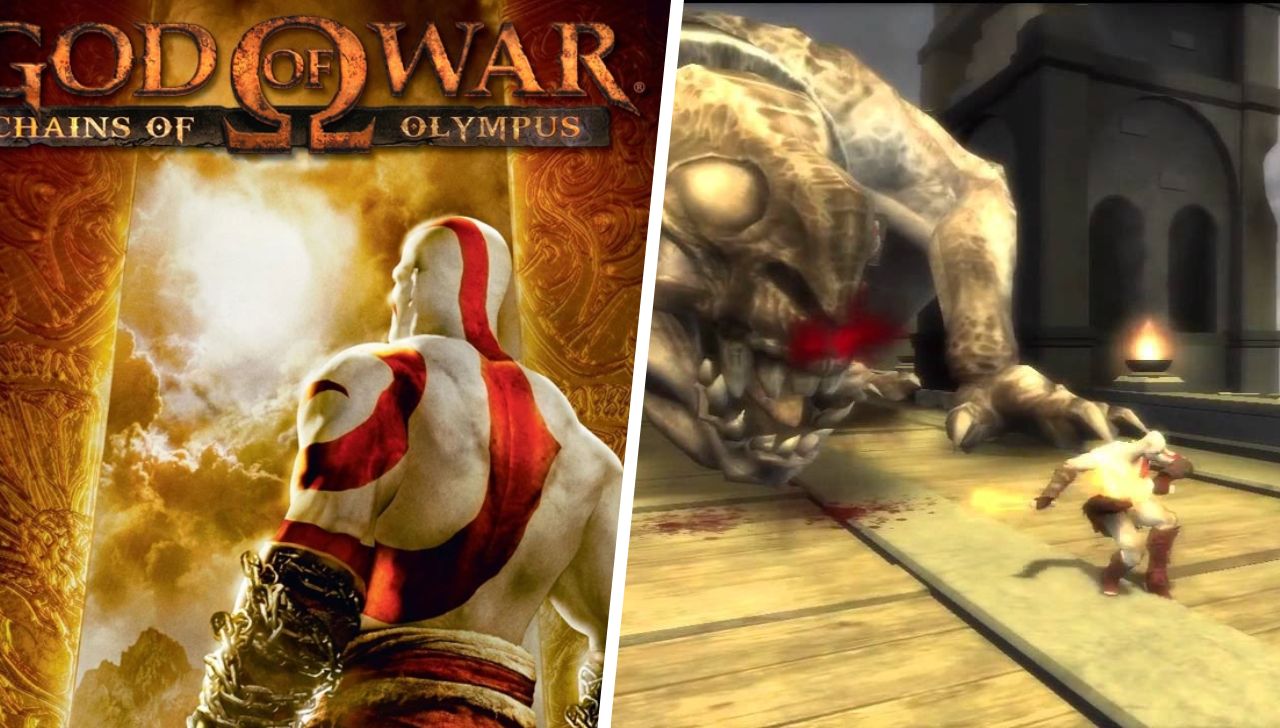
Geminvo – In the mid-200s, the God of War franchise was a colossus, a console-defining behemoth built on epic scale, cinematic violence, and graphical fidelity that pushed the PlayStation 2 to its absolute limits. The series was synonymous with a larger-than-life experience; Kratos battled gods and monsters that filled the entire screen, set against sprawling, ornate backdrops drawn from Greek mythology.
So, when Sony announced that this titan of a series would be coming to its handheld, the PlayStation Portable (PSP), the idea was met with a mixture of excitement and profound skepticism. How could an experience defined by its sheer magnitude possibly be replicated on a pocket-sized device?
The monumental task fell to Ready at Dawn Studios. This was not a random assignment; the developer had already established itself as a technical wizard on the platform with Daxter, a spin-off from the Jak & Daxter universe that was lauded for its fantastic visuals and fun gameplay mechanics. Sony was betting that this team could achieve the impossible. The result, released in 2008, was
God of War: Chains of Olympus, a game that was far more than a simple port or a forgettable side-story. It was a groundbreaking technical achievement that redefined the perceived limits of handheld gaming, a masterclass in platform-aware design, and, most importantly, a vital and emotionally devastating chapter in the tragic saga of Kratos.
The very existence of this project was a statement of intent from Sony. By tasking Ready at Dawn with creating a no-compromise God of War: Chains of Olympus experience, the company was using one of its flagship IPs to validate the PSP hardware itself. This was not just about expanding a franchise; it was about proving that the PSP was a home for console-quality experiences, a system capable of delivering the same epic scope and intensity as its home console brethren. In this, Ready at Dawn succeeded beyond all expectations, creating a title that served as both a system seller and a technical showcase that elevated the entire platform’s prestige.
The Ghost of Sparta in Servitude: Forging Kratos’s Chains
To fully appreciate the narrative weight of God of War: Chains of Olympus, one must understand its precise, and poignant, placement in the series’ timeline. The game is set halfway through Kratos’s decade of forced servitude to the Olympian gods, chronologically taking place after the events of God of War: Ascension but five years before the original God of War. This is a Kratos already broken by the murder of his wife and daughter—an act he was tricked into by Ares—and desperately serving the gods in the hope that they will one day free him from the tormenting nightmares of his past.
The game opens with Kratos acting as the gods’ divine enforcer, dispatched to the city of Attica to repel an invading Persian army. In typical fashion, he succeeds with brutal efficiency, slaying the Persian King and a monstrous basilisk the army brought with them. Yet, no sooner has he completed his task than a new crisis emerges: the sun god, Helios, is violently ripped from the sky, plunging the entire world into an oppressive darkness. In the absence of light, the dream god, Morpheus, casts a black fog over the land, causing the gods themselves to fall into a deep slumber.
Guided by the goddess Athena, Kratos is given a new mission: find and restore Helios to the sky. His quest takes him through the fog-shrouded city of Marathon, into the fallen Temple of Helios, through the subterranean Caves of Olympus, and ultimately forces a descent into the Underworld itself, from the Gates of Hades to the depths of Tartarus.
This narrative framework is more than just a setup for another adventure; it serves as a perfect microcosm of Kratos’s entire fraught relationship with the Olympian pantheon. The gods are in peril not because of some external threat, but because of their own internal strife and negligence. They are powerless in the face of Morpheus’s fog and require their mortal tool, Kratos, to solve a problem of their own making. He is their weapon, their celestial janitor, sent to clean up messes they are too inept or unwilling to handle themselves.
The events of the game are a formative experience that deepens Kratos’s simmering rage, proving to him that his servitude is a one-way street. As the game’s ending cruelly demonstrates, when Kratos succeeds and saves them all, his reward is not relief, but further betrayal. Athena and Helios simply abandon his unconscious body on the Suicide Bluffs, their promise to end his suffering callously ignored. This isn’t just another quest; it is a crucial lesson that cements his understanding that to the gods, his pain is meaningless. This provides the essential context for his desperation at the start of God of War (2005), where his ten years of futile service have finally pushed him to the brink.
A Heartbreaking Choice: The Tragedy of Elysium
While the initial quest revolves around Helios, the true heart of the Chains of Olympus story lies in the Underworld, where Kratos confronts the game’s true antagonist: Persephone, the Queen of the Underworld. Her motivation is not one of simple conquest but of absolute, nihilistic oblivion.
Embittered by Zeus’s betrayal that led to her being trapped in a loveless marriage with Hades, she masterminded the abduction of Helios. Her plan was to use the sun god’s power to free the Titan Atlas from his chains in Tartarus, allowing him to destroy the Pillar of the World—the very foundation supporting both Olympus and the mortal realm. Her goal was to end all of existence, taking her divine tormentors with her.
To achieve this, she presents Kratos with the ultimate temptation, the one thing his soul craves more than vengeance or freedom: a chance to be reunited with his deceased daughter, Calliope. In the tranquil Fields of Elysium, he hears her melody and sees her spirit. Persephone offers him a choice: he can enter Elysium and be with his child for eternity, but only if he renounces his power. He must pour every ounce of his rage, his godly strength, and his Spartan identity—symbolized by the Blades of Chaos—into a mystical tree, shedding the mantle of the Ghost of Sparta to become a powerless shade.
Without hesitation, Kratos accepts. In a beautifully rendered and deeply moving sequence, he sacrifices his power, and for a brief, peaceful moment, he embraces his daughter, his torment seemingly at an end. But this peace is a lie. Persephone reveals her apocalyptic plan, explaining that the destruction of the Pillar will also obliterate the Underworld, meaning the souls in Elysium, including Calliope, will be destroyed forever. Kratos is faced with the cruelest choice imaginable: remain with his daughter and allow her to be annihilated, or save her by abandoning her forever.
This moment is the thematic core of Kratos’s entire Greek saga. Unlike the murder of his family, where he was a pawn acting in a blind, manipulated rage, this decision is made with full, agonizing clarity. To save Calliope, he must willingly inflict the pain of separation upon them both. He reclaims his power by brutally attacking the innocent souls of Elysium, their essence fueling his return to a god-killing warrior. He turns his back on his crying daughter, who begs him not to leave, and chooses his damnation to ensure her eternal peace. This act of conscious self-destruction transforms his tragedy. It is no longer something that simply
happened to him; it is a torment he must actively choose. This is what forges the bottomless, self-hating rage that fuels his war against Olympus in God of War III. His anger is not just aimed at the gods; it is aimed at himself for being trapped in a cycle where saving the world requires him to destroy his own soul. The final battle against Persephone, God of War’s tragic queen, is not just a boss fight; it’s the physical manifestation of Kratos sealing his own fate.
Unchaining Olympus on the Go: A Masterclass in Gameplay Adaptation
Translating the visceral, fluid combat of God of War to the PSP‘s more limited button layout was a monumental challenge, yet Ready at Dawn executed it with near-perfect precision. The studio flawlessly replicated the series’ signature combo-based combat, earning praise from critics who noted that Kratos’s move set felt identical to that of God of War II and that the controls were “extremely responsive”. The fundamental loop of using light (Square) and heavy (Triangle) attacks, mixed with grabs (Circle), remained wholly intact, ensuring that the Kratos handheld debut felt authentic from the very first encounter.
The most ingenious work, however, was in the adaptation of the control scheme. The PSP lacks the DualShock’s second analog stick (used for dodging) and the L2/R2 shoulder buttons. Ready at Dawn’s solution was both simple and brilliant. Dodging was mapped to pressing the L and R shoulder buttons simultaneously while moving the analog nub.
This was hailed by IGN‘s review as a system that “works even better than on the PS2 pad,” as it allowed the player to evade without ever having to move their thumb off the crucial face buttons. Similarly, magic abilities were assigned to holding the R button and pressing a corresponding face button, creating a more deliberate and less error-prone system than the PS2’s D-pad selection.
The game also introduced new and memorable tools of destruction to the Spartan’s arsenal. The Gauntlet of Zeus, a powerful, fist-based weapon used for heavy-hitting brawling, quickly became a fan-favorite addition for its satisfying impact. New magic spells, such as the area-of-effect Efreet and the projectile-based Light of Dawn, provided fresh tactical options for crowd control and ranged attacks.
Despite this success, some critics labeled the game “God of War: Lite,” pointing out that it was more combat-heavy and featured fewer and simpler puzzles and platforming sections compared to its console counterparts. However, this critique arguably misinterprets what was a deliberate and intelligent example of platform-aware design. The PSP was a handheld device, intended for shorter, more interruptible play sessions.
By streamlining the experience to focus on high-density action—reducing complex, multi-stage puzzles and long stretches of exploration—Ready at Dawn ensured a player could pick up the device, engage in a satisfying, high-octane combat sequence, and put it down without losing their place. The game’s shorter length of six to seven hours and more frequent checkpoints further support this “pick-up-and-play” philosophy. The “stripped-down” nature was not a flaw but a feature, perfectly tailored to the hardware and its intended use case.
A Technical Titan: How Ready at Dawn Conquered the PSP
Beyond its gameplay and narrative, God of War: Chains of Olympus is remembered as a staggering technical accomplishment. Upon its release, it was universally declared a visual masterpiece and arguably the best-looking game ever made for the PSP, setting a new benchmark for the platform. Reviewers were stunned by its graphical fidelity, with IGN’s review stating that its animation, environments, and texture work were “on par with what you’ll find in the PS2 titles”. The development team at Ready at Dawn, God of War‘s handheld custodians, successfully maintained the franchise’s signature sense of epic scale, rendering massive set pieces and breathtaking vistas without compromising performance.
Perhaps the most lauded technical feat was the game’s near-complete elimination of loading screens. After the initial load from the UMD or memory stick, the experience was seamless, allowing players to journey from the shores of Attica to the depths of Tartarus without a single interruption. This was an achievement unheard of on the platform at the time and contributed immensely to the game’s immersive quality.
This level of performance was not achieved by simply working within the PSP‘s known limits; Ready at Dawn actively pushed to expand them. The studio’s work was so impressive that they successfully convinced Sony to issue a firmware update for the PSP that unlocked the console’s full 333 MHz processor speed, a move that allowed them to squeeze every last drop of power from the machine, albeit at the cost of some battery life.
The technical prowess demonstrated in Chains of Olympus had a significant ripple effect across the gaming industry. It definitively proved that a console-level, AAA experience was not only possible on a portable device but could also be critically and commercially successful. This raised the bar for both consumer expectations and developer ambition in the handheld space. For years to come, any ambitious action title released on a portable system was inevitably measured against the gold standard that Ready at Dawn had established. The game served as a technical blueprint, showing other major publishers that investing heavily in handheld versions of their flagship franchises was a viable and rewarding strategy.
Legacy and Critical Echoes: A Masterpiece with an Asterisk
Upon release, God of War: Chains of Olympus was met with universal acclaim from critics. It earned a Metascore of 91, making it the highest-rated PSP game on Metacritic, a distinction it held for years. The game won numerous “Best of E3” and “Game of the Year” awards for a handheld title, with specific praise directed at its action gameplay, stunning graphics, and powerful sound design. It was a bona fide hit, proving that Kratos was just as compelling on a small screen as he was on a large one.
However, a fascinating duality emerged in its critical reception. When judged as a PSP game, it was almost unanimously considered a 10/10 masterpiece, a phenomenal and unparalleled achievement for the hardware. Yet, when viewed as a
God of War game, it was often described as excellent but slightly lacking in the grandiosity of its console brethren, leading to the recurring “God of War-lite” label. This asterisk, however, does little to diminish its profound and lasting legacy.
The game’s impact is twofold. First, it shattered the preconceived notions of what was possible in handheld gaming, proving that massive, graphically intensive, and mechanically complex action franchises could thrive on a portable system. It stands as one of the very best PSP games ever made. Second, and perhaps more importantly for the series’ faithful, it added an indispensable and emotionally resonant layer to Kratos’s character arc. The events in Elysium are not skippable lore; they are fundamental to understanding the depths of his rage and the tragedy of his existence.
Furthermore, the incredible success of Chains of Olympus—which sold over 3.2 million copies —created a successful and profitable template for the “AAA Interquel.” This model, where a trusted partner studio develops a story-rich installment on a secondary platform to fill narrative gaps between mainline releases, was validated by this game. Its success led directly to Sony greenlighting a second PSP title with Ready at Dawn,
God of War: Ghost of Sparta, and established a business strategy that allowed publishers to keep franchises in the public eye, expand their lore, and generate revenue during the long development cycles of major console sequels.
Conclusion: The True Weight of the Chains
God of War: Chains of Olympus is a game of dual identities. It is a technical titan that pushed its hardware to the breaking point, a testament to the ingenuity and ambition of Ready at Dawn. Simultaneously, it is a narrative heavyweight that burdened its protagonist with his most devastating and personal trial. The “chains” of the title are as metaphorical as they are literal, referring not only to the iconic blades seared to Kratos’s flesh but also to the unbreakable bonds of his servitude to the gods and the tragic memories of a past he can never truly escape.
To dismiss this game as a mere “side story” is to miss one of the most crucial pillars of the entire franchise. It is not an optional chapter but an essential text, providing the emotional bedrock for Kratos’s subsequent war on Olympus. It stands today as a monumental achievement in game development, a defining moment for the PlayStation Portable, and a poignant, unforgettable chapter in one of gaming’s most iconic tragedies. Discover fascinating game insights in Revan’s latest articles! Stay updated daily by Following Geminvo on Instagram, X (Twitter), Facebook, YouTube & TikTok.
Summary of God of War Chains of Olympus
- A Technical Benchmark for Handhelds: God of War: Chains of Olympus was a groundbreaking technical achievement, widely considered the best-looking and best-performing game on the PSP. It proved that a console-quality AAA experience was possible on a portable device.
- Crucial Narrative Placement: Set midway through Kratos’s 10-year servitude to the gods, the game provides vital context for his growing rage and disillusionment with the Olympians, directly setting the stage for the original God of War.
- The Emotional Core of the Saga: The game’s central plot point—forcing Kratos to consciously and willingly abandon his daughter Calliope in Elysium to save her—is one of the most tragic and character-defining moments in the entire series. It transforms his suffering from something inflicted upon him to a fate he must actively choose.
- Masterful Gameplay Adaptation: Ready at Dawn successfully translated the series’ fluid, combo-based combat to the PSP’s limited controls, with some adaptations, like the dodge mechanic, being hailed as improvements over the console versions.
- Platform-Aware Design: While shorter and more combat-focused than its PS2 counterparts, the game’s design was deliberately tailored for a portable, “pick-up-and-play” experience, prioritizing high-density action over complex puzzles.
- Lasting Legacy: The game’s critical and commercial success established a viable model for “AAA Interquels” on secondary platforms, set a new standard for handheld game development, and added an indispensable layer of emotional depth to Kratos’s character.