
# A deep dive into the development of two PS2 classics. Discover how Dragon Quest VIII and Dark Cloud 2 were made by Level-5, from innovative gameplay to iconic art.
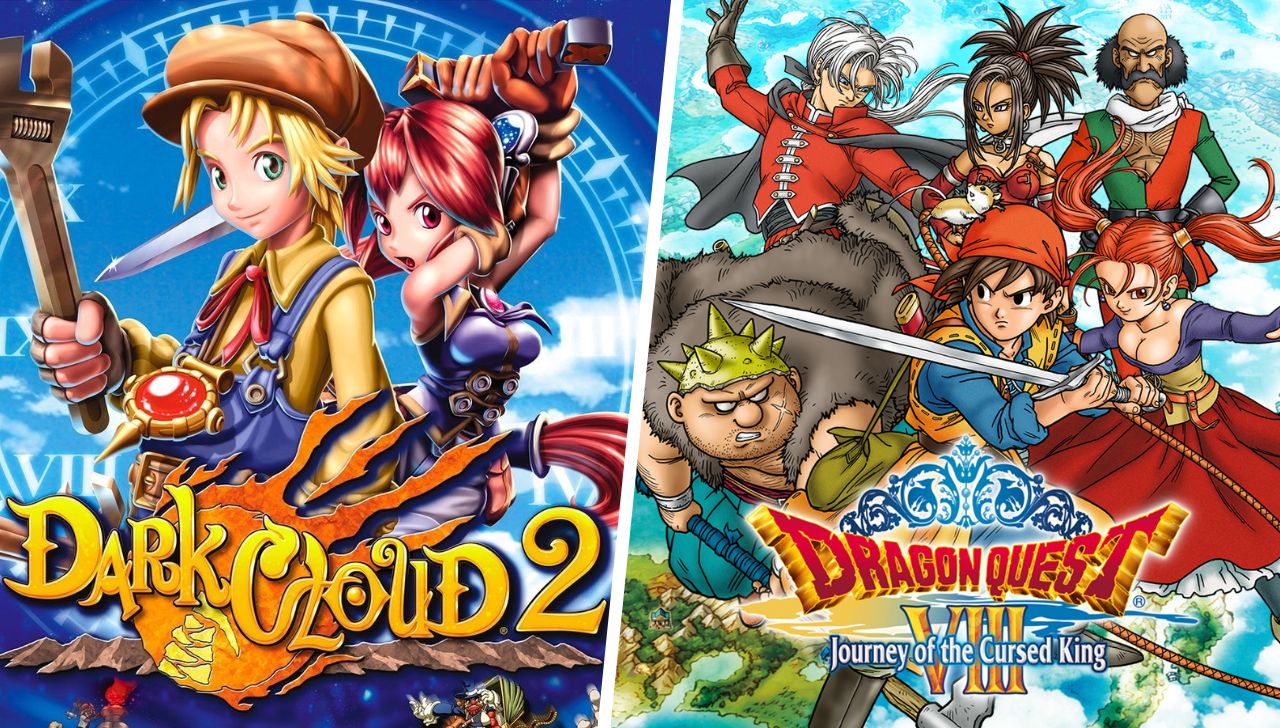
Geminvo – The early 2000s were a golden age for the Japanese Role-Playing Game (JRPG), and the PlayStation 2 was its grand stage. Amidst a landscape dominated by established giants, a relatively new studio named Level-5, founded in October 1998 by the ambitious Akihiro Hino, was quietly preparing to make its mark. Hino, a former programmer and director who left a larger company because he “wanted to do something creative, something new,” established his studio of just 11 employees with a simple but powerful name: the “five” stood for five stars, a constant reminder of the quality they aimed to achieve.
This is the story of how that small, ambitious studio produced two of the generation’s most defining, yet fundamentally different, JRPGs. It is an exploration of how Dragon Quest VIII and Dark Cloud 2 were made—a journey that saw Level-5 first prove its worth with a wildly creative sequel before solidifying its legend by reinvigorating one of gaming’s most revered franchises.
Dark Cloud 2 (Dark Chronicle) – The Audition Piece
Before Level-5 could take the reins of a legendary series, it first had to prove it was capable of creating a legend of its own. That proof came in the form of Dark Cloud 2, known as Dark Chronicle in Japan and Europe—a game that was far more than just a sequel.
A “High-Profile RPG” Built from Scratch
Following the release of their debut title, Dark Cloud, Hino and his team felt they had left unfinished business. In a 2003 Akihiro Hino interview, he stated that they felt they hadn’t created a “complete version” of their initial concept and wanted to make their next project something “entirely different” and much bigger. This ambition led to a pivotal decision in the Level-5 development history: instead of iterating on the original game’s foundation, they scrapped the engine and tools entirely and started from scratch.
The rationale was bold. Hino explained that to “make full use of this progress [in technology] and to surpass the techniques of the major companies, it is easier for us to create a game from scratch”. At the time, Level-5 was still a small “satellite of Sony,” a relative underdog in a field of titans like Square and Enix. To get noticed, they needed to do more than just make a good game; they needed to demonstrate overwhelming technical and creative competence.
The development of Dark Cloud 2 was, therefore, not merely a creative endeavor but a calculated, strategic move—an audition piece for the entire industry. By building a new engine and packing the game with ambitious, interconnected systems, Level-5 was publicly demonstrating that it had the vision and the technical prowess to handle a premier, top-tier franchise.
A Story That Bends Time
The narrative of Dark Cloud 2 is as ambitious as its design. The story centers on two protagonists from different eras: Max, a brilliant young inventor from the present-day town of Palm Brinks, and Monica, a brave princess from 100 years in the future. They are brought together by magical stones called Atlamillia, which allow them to travel through time. Their mission is to stop the villainous Emperor Griffon, who is systematically destroying key locations in Max’s past to erase Monica’s future from existence.
The plot masterfully intertwines with the gameplay. As the player rebuilds the world in Max’s time using the Georama system, they can then travel to Monica’s future to see the tangible results of their work, often unlocking new characters, items, and story progression points. This creates a powerful and satisfying loop where the player’s actions have a direct and visible impact on the game’s world and history. Initial previews described the main characters as Yuris (an early name for Max), a 13-year-old mechanical genius, and Monica, a 15-year-old swordswoman whose magical abilities hinted at an unusual past.
The “Maximalist” Sandbox
Dark Cloud 2 is a masterclass in “maximalist” game design, a veritable sandbox of creative and engaging systems that all feed into one another.
At its heart is the evolved Dark Cloud 2 Georama system. Where the first game focused on restoring towns to a specific blueprint, the sequel gave players immense creative freedom to design and build their own unique settlements. The goal was to make the world feel less like it was built from “individual Tinkertoy bits” and more like a cohesive, living environment. Players had to gather materials, craft components, and place everything from houses and rivers to trees and fences, all while fulfilling certain conditions to advance the story and restore the future.
Layered on top of this was the groundbreaking invention system. Using Max’s camera, players could take photographs of hundreds of objects throughout the world. These photos became “ideas,” and by combining three specific ideas, Max could invent new items, powerful weapon upgrades, and custom parts for his robotic companion, the Ridepod. This system rewarded curiosity and experimentation like few RPGs before it, encouraging players to look at every corner of the world as a potential source of inspiration.
The game’s sheer breadth of content was staggering. It featured a deep fishing mini-game with its own rod-leveling system, fish breeding, and competitive races called the “Finny Frenzy”. In cleared dungeon floors, players could engage in Spheda, a unique and challenging golf-like game that yielded valuable treasures. Max could pilot his fully customizable Ridepod, “Steve,” while Monica could transform into various monsters to use their abilities.
Crucially, Dark Cloud 2 addressed nearly every major complaint from its predecessor. The annoying thirst meter was gone, and weapon breakage was made far less punishing—instead of disappearing, a broken weapon would simply lose some of its accumulated experience (ABS). The combat was also made more fluid and dynamic, with new moves like backflips and the ability to throw objects and even smaller enemies.
An Artistic Identity Forged in “Tonal Rendering”
Visually, Dark Cloud 2 established a signature style for Level-5. The game employed a beautiful cel-shaded aesthetic, which the developers referred to in early previews as “tonal rendering”. This technique gave the characters a “smoothly shaded look,” allowing for vibrant colors and expressive animations that felt like a living cartoon, while backgrounds featured more detailed textures and lighting than the first game.
This artistic direction was more than just an aesthetic choice; it was a crucial research and development phase. Cel-shading was a popular but technically demanding style during the PlayStation 2 era, and by dedicating themselves to mastering it with Dark Cloud 2, Level-5 was honing the very tools and techniques they would need for their next, even more ambitious project. This work on their own IP served as the technical and artistic foundation that made them the perfect, and perhaps only, developer at the time capable of tackling the immense challenge of bringing the world of Dragon Quest into 3D.
Dragon Quest VIII – The Coronation
With the critical and commercial success of Dark Cloud 2 serving as their proof of concept, Level-5 was ready for the main event. The story of how Dragon Quest VIII and Dark Cloud 2 were made is one of symbiotic progression, where the lessons learned from the first project directly enabled the legendary success of the second.
The Unlikely Partnership: From Critique to Creation
The tale of how Level-5 landed the opportunity to develop a mainline Dragon Quest title is now the stuff of industry legend. Akihiro Hino, a lifelong fan of the series, had played Dragon Quest VII and, emboldened by his experience developing Dark Cloud, had strong opinions on how the series could evolve. He boldly approached a Square Enix producer, either at a party or via a phone call, and passionately shared his feedback. The producer, who was already impressed by Level-5’s work, was so taken by Hino’s vision and enthusiasm that he issued a challenge: “Why don’t you have a go yourself?”.
This was a watershed moment. The credibility Level-5 had built with their highly polished and technically advanced “audition piece” gave their pitch the weight it needed. They had proven they could deliver a “high-profile RPG,” and now they were being handed the keys to the most beloved JRPG series in Japan.
The Cursed King’s Epic Journey
Dragon Quest VIII: Journey of the Cursed King tells a classic, fairy-tale story with immense heart and charm. The game opens in the immediate aftermath of a terrible curse. The wicked court jester, Dhoulmagus, has stolen a magical scepter and used it to transform King Trode into a diminutive troll-like creature, Princess Medea into a horse, and the inhabitants of Trodain castle into thorny plants. The only person unaffected is the player character, a loyal royal guard known only as the Hero.
The trio sets off on an epic, continent-spanning quest to find Dhoulmagus and reverse the spell. Along the way, they are joined by a memorable cast of companions: Yangus, a gruff bandit with a heart of gold who owes the Hero a life debt; Jessica Albert, a fiery and powerful mage seeking revenge for her brother’s murder; and Angelo, a suave and flirtatious Templar Knight with a complicated past. While the main plot is a straightforward pursuit of a villain, the game’s true narrative strength lies in its character-driven vignettes and deeper themes of forgiveness, overcoming resentment, and the discovery of one’s true identity.
Artistic Triumph: Bringing Akira Toriyama’s World to Life
The greatest challenge facing Level-5 was translating the iconic 2D art of Akira Toriyama—the legendary artist behind Dragon Ball and every Dragon Quest game—into a fully three-dimensional world for the first time. Failure to capture the charm and expressiveness of his style would have been disastrous.
This is where the studio’s prior work paid off spectacularly. Leveraging the cel-shading mastery they had perfected on Dark Cloud 2, Level-5 brought Toriyama’s characters to life with breathtaking fidelity. The combination of their technical skill and Toriyama’s beloved designs resulted in character models that looked “beautifully hand-drawn” and moved with a fluidity that felt both modern and true to the source material. This successful translation of the Akira Toriyama 3D art style was a monumental achievement.
Furthermore, Hino’s insistence on a 3D presentation was a strategic move aimed at global audiences. He correctly believed that to become a “global standard,” the series needed to adopt the fully explorable 3D worlds that Western players had come to expect. The art style became a bridge between two cultures. It preserved the unmistakable charm of Toriyama’s art that Japanese fans adored while presenting it in a grand, immersive format that finally allowed the series to find a sizable audience in the West.
Tradition Reimagined and Perfected
The Dragon Quest VIII gameplay did not seek to reinvent the JRPG, but to perfect it. Level-5 took the series’ traditional turn-based foundation and enhanced it with several brilliant, modern mechanics.
The most significant addition was the Tension system. In combat, characters could spend a turn to “Psyche Up,” forgoing an action to build Tension. This could be done multiple times, with each level of Tension dramatically increasing the power of the next attack or spell. This simple mechanic added a profound layer of risk-reward strategy to every battle, forcing players to decide between consistent small attacks or building up for a devastating, tide-turning blow.
Another beloved feature was the Alchemy Pot. Acquired early in the journey, this magical pot allowed players to combine two (and later, three) items to create entirely new and often powerful equipment, accessories, and consumables. The pot would “cook” the recipe as the player traveled the world, creating an addictive loop of experimentation and discovery. Finding a recipe for a powerful sword that would cost a fortune in a shop was an incredibly rewarding experience.
Finally, the Skill Point system offered deep and meaningful character customization. With each level up, characters earned points that could be invested into one of five skill trees—typically three weapon types and two unique character attributes like the Hero’s “Courage” or Jessica’s “Sex Appeal”. Investing points unlocked powerful new abilities and passive stat boosts. On the original PS2 version, these choices were permanent, making every point allocation a significant decision that shaped a character’s role in the party for the entire game.
A Shared Legacy of Divergent Philosophies
Looking back at how Dragon Quest VIII and Dark Cloud 2 were made reveals a developer with a rare and remarkable versatility. Within a two-year span, Level-5 mastered two opposing design philosophies, with each game informing the other.
Dark Cloud 2 is a game defined by its systemic depth and player-driven creativity. Its design is “maximalist,” offering a sandbox of interconnected systems—the Dark Cloud 2 Georama system, photography, invention, fishing, Spheda—that empower the player to create and experiment. Its joy comes from making. In contrast, Dragon Quest VIII is a game defined by its flawless execution and journey-driven adventure. Its design is “perfectionist,” focusing on refining a timeless JRPG formula to its absolute peak. Its joy comes from experiencing a grand, polished, and masterfully crafted quest.
The boundless, almost chaotic creativity of Dark Cloud 2 served as the ultimate training ground. It taught Level-5 how to build vast 3D worlds, create compelling gameplay loops, and master their cel-shading technology. They then applied that hard-won experience with the focus and reverence required to perfect a legendary series in Dragon Quest VIII. One game was about building everything; the other was about perfecting one thing. The same master craftsmen built both.
The Mark of a Master
The journey of Level-5 through the PlayStation 2 era is a testament to ambition, craftsmanship, and strategic vision. Their story begins with an audacious “audition” in Dark Cloud 2, a game so packed with innovation and technical polish that it forced the industry to take notice. That success paved the way for their “coronation” with Dragon Quest VIII, where they took on the immense pressure of modernizing a national treasure and succeeded beyond all expectations, finally introducing the series to a global audience.
These two titles, born from different philosophies but forged in the same creative fire, cemented Level-5’s reputation as one of the most important and skilled JRPG developers of their generation. The story of how Dragon Quest VIII and Dark Cloud 2 were made is more than just a look at two classic games; it is the story of how a small studio with five-star ambitions became true masters of their craft, leaving an indelible mark on the PlayStation 2 and the JRPG genre forever.
Article Summary of How Dragon Quest VIII and Dark Cloud 2 Were Made
- Level-5’s development of Dark Cloud 2 was a technical and creative showcase, serving as a strategic “audition” that proved their capability to handle a major franchise by building a new engine from scratch.
- Dark Cloud 2 is defined by its “maximalist” design, featuring a wealth of interconnected systems like the Georama town-building, a unique photography-based invention mechanic, and numerous mini-games.
- Level-5 secured the Dragon Quest VIII project after founder Akihiro Hino passionately critiqued Dragon Quest VII to a producer, impressing Square Enix with his vision and the proven quality of Dark Cloud.
- Dragon Quest VIII was a landmark achievement in translating Akira Toriyama’s iconic 2D art style into a fully 3D world, using a cel-shading technique that Level-5 had mastered during the development of Dark Cloud 2.
- The Dragon Quest VIII gameplay perfected the traditional JRPG formula with brilliant strategic additions like the risk-reward Tension system, the addictive Alchemy Pot for crafting, and a meaningful Skill Point system for character customization.
- Together, the two games demonstrate Level-5’s mastery of two distinct design philosophies: the boundless, player-driven creativity of Dark Cloud 2 and the polished, refined traditionalism of Dragon Quest VIII.